Introduction
If you’re tired of spending hundreds of dollars on a coverstitch machine that still can’t give you those clean, professional-looking hems — keep reading.
The Janome CoverPro 1000CPX keeps popping up everywhere, but is it really as good as people say — or is it just another overhyped machine that will collect dust in your sewing room?
When I purchased the Janome CoverPro 1000CPX on 12th March, I was honestly skeptical about my decision. I kept asking myself — did I just waste my money?
However, when the machine arrived and I unboxed it, I was excited to finally put it to the test.
So instead of just sewing a few simple seams and calling it a review, I put this machine through 5 brutal tests to find out if my decision was worth it or not.
And believe me — the results will shock you.
Yes, this machine has some flaws, and I’m going to be completely honest about them.
But even with those flaws, it still outperforms every single coverstitch machine I’ve ever owned.
Every. Single. One.
Table of Contents
Quick TLDR:
The Janome CoverPro 1000CPX is a powerful coverstitch machine that produces professional results on stable knits and heavy fabrics, but it fights you on slippery lycra, tight circles, and sudden speed changes. It rewards experienced sewers who take time to dial in settings — beginners will struggle and curse. Worth the money if you sew knits regularly, not worth the headache if you just sew occasionally.
At-a-glance: Janome CoverPro 1000CPX Specs
| Feature | Detail |
|---|---|
| Machine Type | Dedicated coverstitch only |
| Threads | 2, 3, or 4 thread capability |
| Max Speed | 1,000 stitches per minute |
| Stitch Length | 1mm – 4mm adjustable |
| Differential Feed | 0.5 – 2.25 adjustable |
| Free Arm | Yes — industry exclusive |
| Seam Tightening System | Yes — spring-loaded looper control |
| Needles | Schmetz ELx705 size 12 only |
| Sewing Area | 4" x 5.5" |
| Threading | Color-coded guide system |
| Auto Needle Threader | No |
| Auto Tension | No — fully manual |
| Heavy Fabric Handling | Excellent — denim, corduroy, fleece |
| Lycra / Slippery Fabric | Manageable with settings adjustment |
What Is Janome CoverPro 1000CPX?
Current Price: $649 On Amazon
Professional coverstitch machine with industry-exclusive free arm, Seam Tightening System, 1000 SPM speed, and 2-3-4 thread capability. Best for intermediate to advanced sewers working regularly with knits, jerseys, and stretch fabrics. Comes with 25-year mechanical warranty.
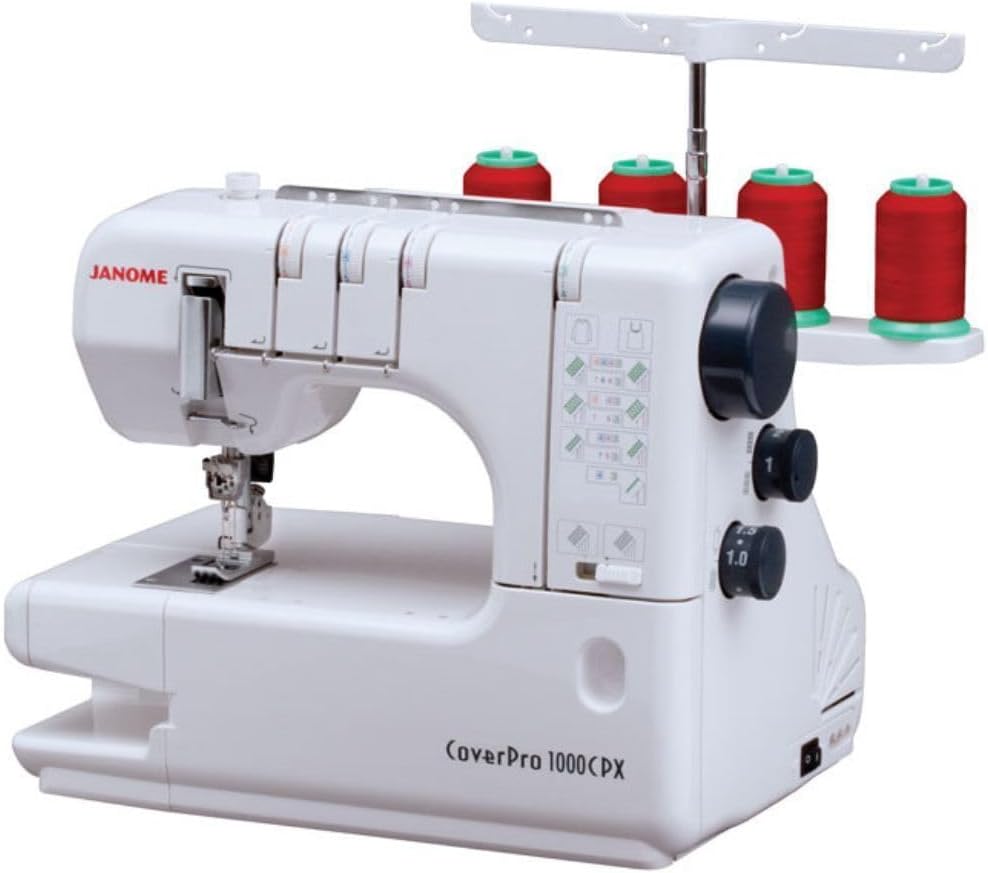

So what exactly is the Janome CoverPro 1000CPX?
Simply put, it’s a dedicated coverstitch machine built to give your garments that clean, professional hem finish.
It runs at speeds up to 1,000 stitches per minute, offers 1, 2, or 3 needle options, a stitch length of 1 to 4mm, stitch width of up to 6mm, and a differential feed ratio of 0.5 to 2.25.
It also comes with Janome’s Seam Tightening System (STS), a free arm, and a vertical needle drop. On paper, it sounds like a beast.
But here’s the thing — don’t let those Amazon specs fool you.
Numbers look great on a product page.
My testing criteria is completely different.
It’s designed to expose the real weaknesses of this machine — across stitch quality, tension control, and fabric handling.
That’s where the truth lives.
Test 1 — Swimwear Lycra & Mesh: A Mixed Bag (And I Won’t Sugarcoat It)
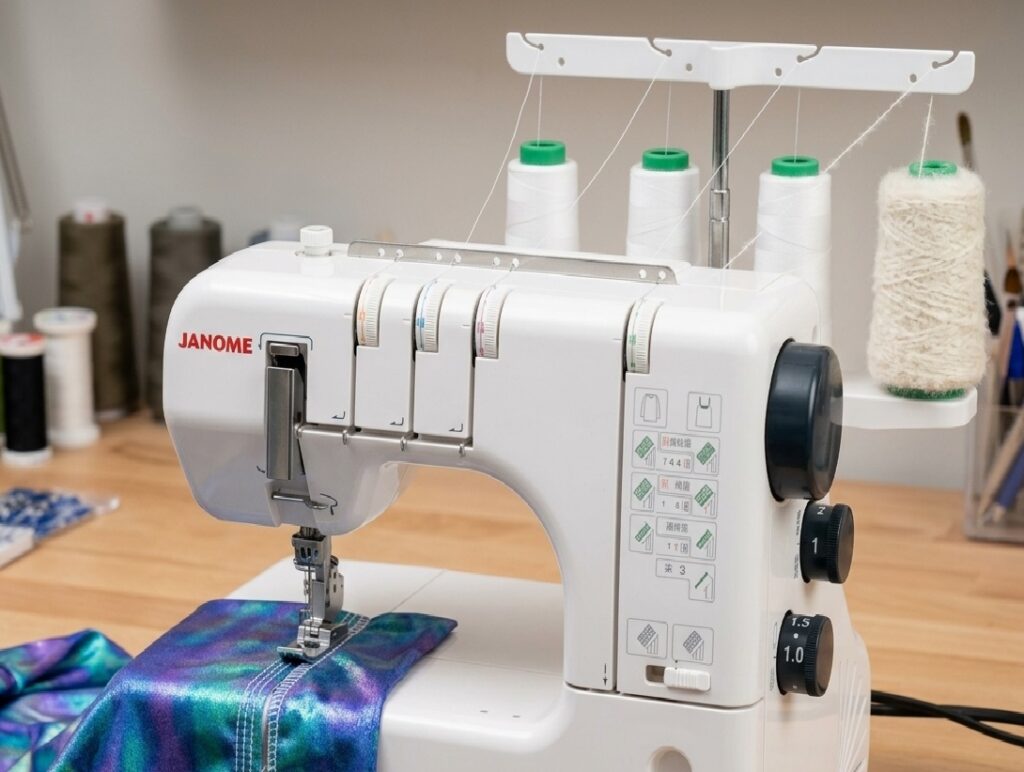
First up — the toughest test. Swimwear lycra. The fabric that breaks most coverstitch machines.
I loaded up a piece of 4-way stretch swimwear lycra, set the differential feed to around 1.5, grabbed my Schmetz ELx705 needle, and hit go. For the first 10 cm, things looked genuinely promising. The top cover threads lay flat and the chain underneath looked clean. I was actually smiling. Then it happened. Right at the start of a new row, using the right two needles on the beefy lycra — it skipped. Not every stitch, not even every row. Just enough to make you want to throw the thing across the room.
Let me be straight with you — this machine gets skipped stitches on lycra-type fabrics, even when you’re using the correct threads and needles. That’s the brutal truth. And it’s not just me. This same complaint comes up again and again across sewing forums. So if you’re buying this machine mainly for swimwear — you need to know this going in.
Now — is it fixable? Mostly yes. Switching to woolly nylon thread in the looper made a noticeable difference. Other experienced users also suggest increasing the top tension slightly and going with a longer stitch length to stop the skipping. After about 20 minutes of fiddling with these settings, the results improved significantly. Not perfect — but much, much better.
One thing I will give this machine credit for — the Seam Tightening System (STS) does its job. It reduces slack in the looper thread and gives you tighter, flatter stitches. You can actually feel the difference compared to cheaper machines. But on true slippery stretch fabrics, it needs coaxing. This is not a plug-and-play situation on difficult fabrics. You have to earn good results here.
Test 2 — Heavy Terry Towelling Hem: This Is Where The Machine Earns Its Money
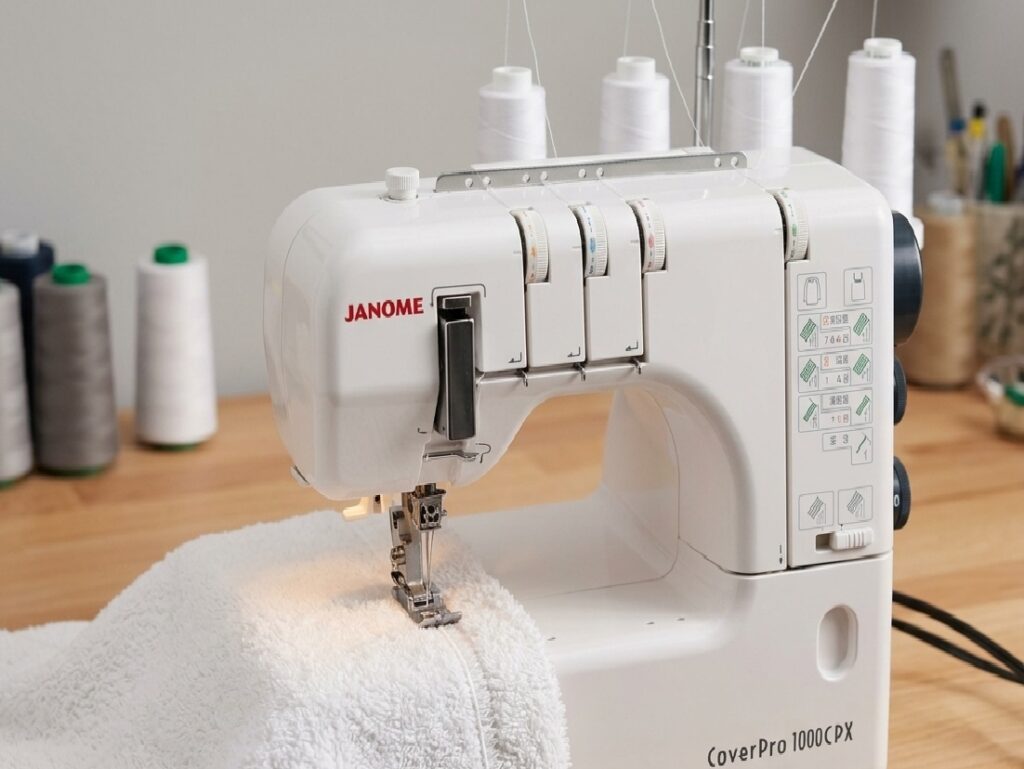
If Test 1 made me nervous, Test 2 brought my confidence back.
I folded a thick cotton terry hem to four layers and sent it straight through. No warm-up, no coaxing. And honestly? The 1000CPX surprised me here. The feed dogs handled all that bulk without dragging or stuttering. Stitch length stayed consistent from start to finish. No broken needles, no thread pops. Just clean, flat, professional stitches.
The Seam Tightening System really shines on heavy fabrics. You can feel it working — keeping the looper thread tight and the stitch flat, even through all that thickness.
But here’s where it stumbles. Seam intersections — those spots where the fabric suddenly jumps from two layers to four — caused skipped stitches. Same problem as Test 1, just a different trigger. Hit a flat section and it’s perfect. Hit a crossing seam and you’re holding your breath.
The fix? Slow down before the bump, use a hump jumper, or gently guide the fabric through by hand. Annoying that you have to babysit it — but once you know the trick, the results are clean and professional.
Test 3 — Tight Circular Hem: The free arm moment of truth.
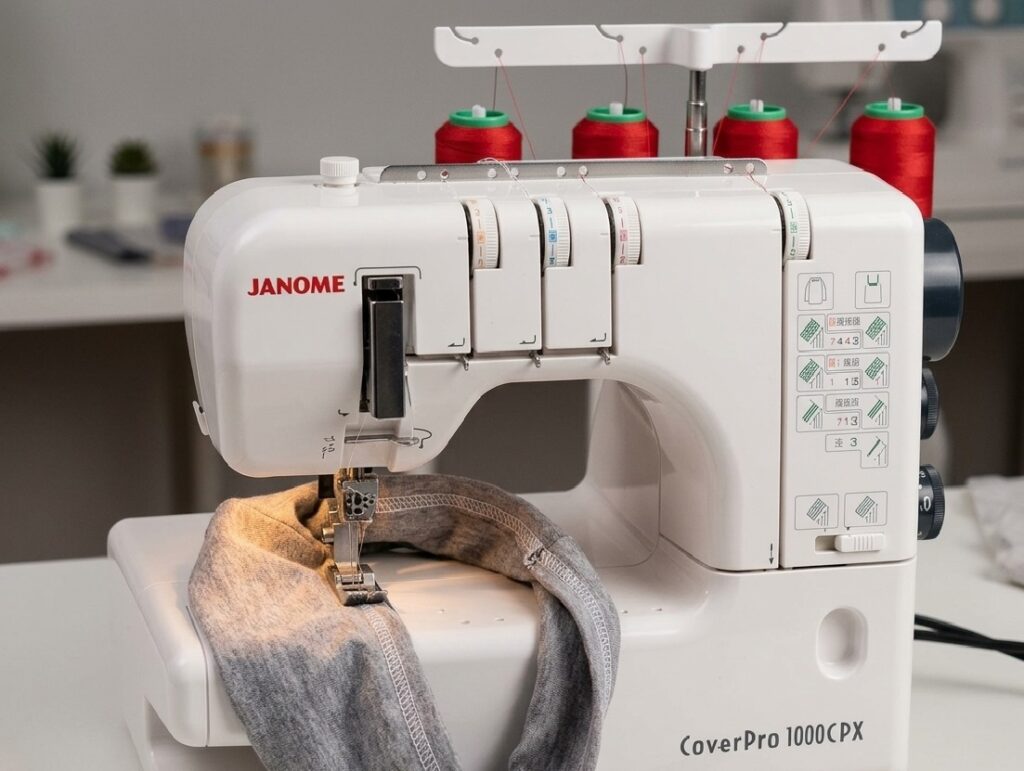
This is the test I was actually excited about, because the free arm is the whole reason you pick this machine over competitors. I slipped a jersey neckband — roughly 18 cm circumference — onto the free arm and started stitching.
First two-thirds of the circle? Genuinely impressive. The free arm gave enough clearance to rotate the tube smoothly without bunching, and the stitches sat flat with zero waviness. I started feeling smug about the purchase.
Then came the overlap — where the end of the stitch meets the beginning. The machine does not ease into that extra layer gracefully. It bumped, the presser foot lifted slightly, and I got two skipped stitches right at the join. On a neckline that the whole world sees. That stings.
The other issue is fabric control on a tight tube. With only 18 cm to work with, you are constantly fighting the fabric trying to twist ahead of the needle. There is no magical auto-guide here — your hands are doing real work the entire time, keeping that tube aligned. Beginners will struggle badly.
Cuff tubes at 22–24 cm were noticeably easier and came out beautifully. The problem scales directly with how small the circle is.
Test 4 — Stretched Elastic Waistband: A patience game.
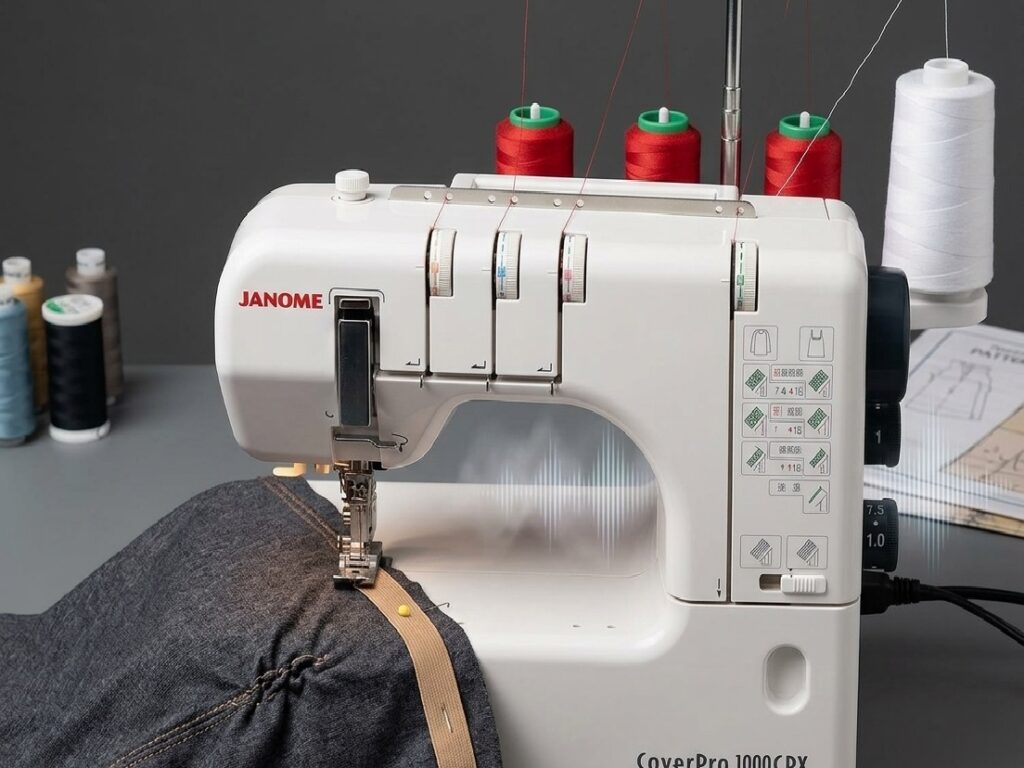
I cut a jersey waistband, grabbed a 1-inch flat elastic, stretched it about 20% and pinned it down. Straightforward setup. Hit the pedal.
The first thing I noticed was the machine humming differently — slightly louder, more resistance. The elastic was fighting back and the machine felt it. For the first 15 cm the stitches looked great, tension balanced, everything lying flat. I was nodding along thinking this was going to be easy.
Then mid-way through, the elastic relaxed slightly in my grip — just a moment of losing control — and the fabric immediately puckered under the foot. Three stitches bunched together like a little mountain. Completely unusable on a visible waistband.
Here is the real problem with this machine on elastic work. It has no built-in elastic guide or dedicated foot for this job in the standard package. You are essentially using two hands to maintain constant even stretch while also guiding the fabric straight. That is three jobs for two hands. Experienced sewers will manage. Anyone newer will rip out a lot of seams.
When I slowed right down and stayed focused, the results were actually excellent. The stitches recovered fully when elastic was released, no thread pops, the coverage looked genuinely professional and RTW quality.
Test 5 — Speed Change Mid-Seam: Does it hold up or fall apart?
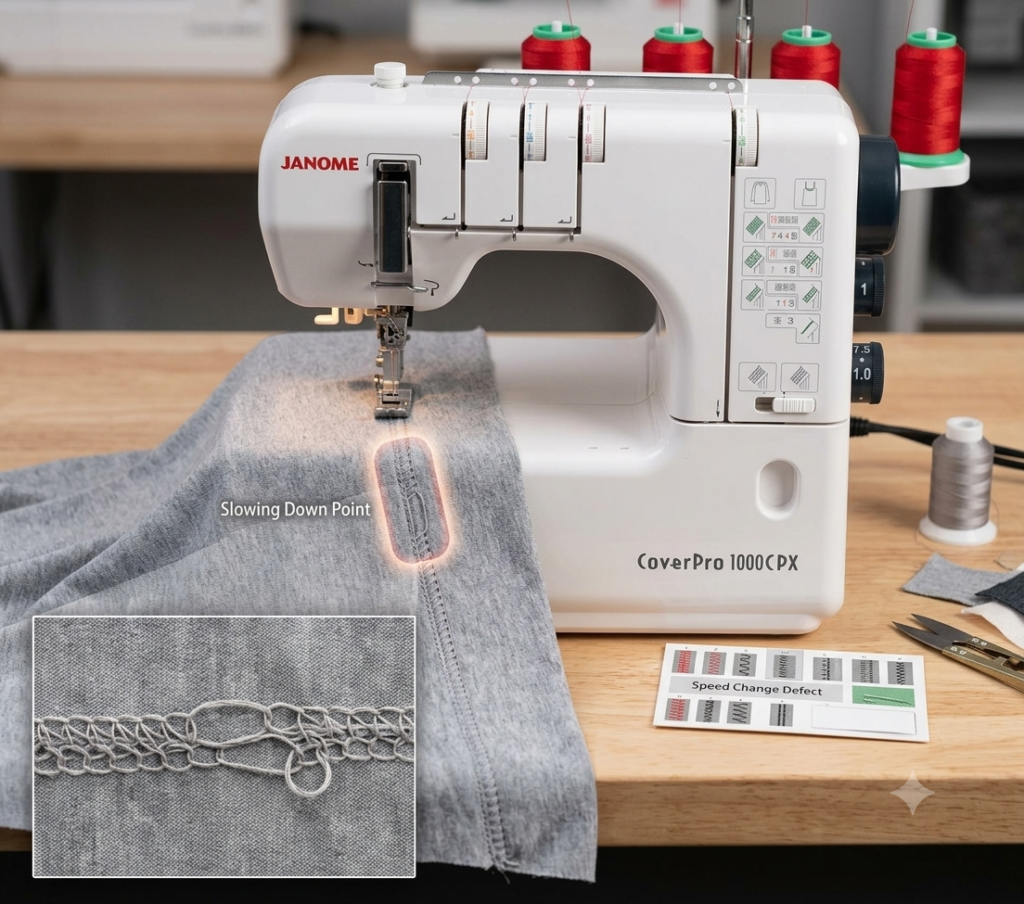
I picked a plain cotton jersey, started at full speed — this thing screams at 1000 stitches per minute and sounds like it means business — then deliberately stomped the pedal to minimum speed right in the middle of a straight hem.
The top side looked fine. Flipped it over and the underside told the real story. Right at the speed transition point, two stitches were noticeably longer than the rest. Not a skip, but a stretch. The looper timing got slightly lazy when the speed dropped suddenly, and the chain underneath showed it immediately.
Pushed it the other way — started slow, punched to full speed mid-seam. Cleaner result surprisingly. The machine handles acceleration better than it handles sudden braking.
This matters in real life because you naturally slow down approaching corners, seam joins, and fabric edges. Every one of those slow-down moments is a potential weak point in your stitch consistency.
Related Articles:
Final Verdict
The 1000CPX is not a perfect machine but it is the best option at this price point for serious home sewers.
The free arm alone sets it apart from every competitor.
Yes it skips stitches on difficult fabrics, yes it needs babysitting on elastic and tight circles, and yes it has a real learning curve.
But once you understand its quirks and work with them rather than against them, it consistently delivers clean professional finishes that you simply cannot achieve on a regular sewing machine.
If you sew knit garments more than twice a month, this machine will pay for itself in time saved and quality gained.
Buy it, learn it, and stop fighting it — that is when it becomes genuinely great.
FAQs
Q: Is the 1000CPX good for beginners?
No. It has a steep learning curve and requires manual tension adjustments. Start here only if you already know basic serging.
Q: Does it skip stitches on lycra?
Yes, occasionally. Woolly nylon in the looper and a longer stitch length fixes it most of the time.
Q: Do I need special needles?
Yes. Only Schmetz ELx705 size 12. No substitutes.
Q: Is the free arm actually useful?
Absolutely — it is the machine’s best feature and the main reason to choose it over competitors.
Q: Can it handle denim and fleece?
Yes, thick stable fabrics are actually where it performs most confidently.
Q: Is it worth the price?
For regular knit sewers, yes. For occasional hobbyists, probably not.