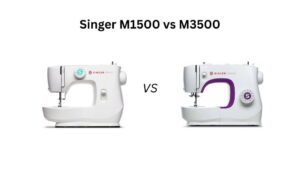
Singer MX60 vs M1500:
The Shocking Truth Nobody Tells You
Singer confirmed these two machines are nearly identical — yet one costs $30 more. Here’s exactly what you get for that extra cash.
Singer MX60 vs M1500: Quick Summary
The Singer MX60 and Singer M1500 are functionally the same sewing machine. Singer officially confirmed the only real differences are cosmetic — but there are two practical distinctions worth knowing: the MX60 uses a top drop-in bobbin (easier for beginners), while the M1500 uses a front-loading bobbin. The MX60 costs $149; the M1500 costs just $119.
Bottom Line: If budget is your priority, the M1500 saves you $30 for identical performance. If ease of bobbin loading matters most, the MX60’s drop-in system is worth the small premium.
Who Are the Singer MX60 & M1500 Really For?
Let’s address the elephant in the room immediately: when a reader asked Singer directly whether the MX60 and M1500 are the same machine, a Singer customer service representative confirmed — in writing — that “the only difference between the two machines is cosmetic.” (Source: Sewing Machine Fun)
So why does this comparison even exist? Because “cosmetic” doesn’t tell the whole story. There are a few practical differences that can genuinely affect your day-to-day sewing experience — especially if you’re brand new. And with a $30 price gap between the two, getting this choice right saves you money or headaches depending on what you value.
Both the Singer MX60 and Singer M1500 belong to Singer’s entry-level lineup — mechanical, beginner-friendly sewing machines designed for three groups:
- Children learning to sew who need a simple, intuitive machine
- Beginners who don’t want to spend a fortune on their first machine
- Experienced sewists looking for a portable or backup machine
Think simple garment alterations, hemming jeans, quilting basics, home décor projects, and everyday mending. These machines were never meant to be workhorses — they’re starter companions. If you need to regularly sew through heavy denim, canvas, or multiple thick layers, you’ll want to look at the Singer Heavy Duty 4411 or 4432 instead.
Side-by-Side: Quick Buy Comparison
Both machines are available on Amazon with free Prime shipping. Prices shown are current at time of publication.
- 57 stitch applications (6 built-in stitches)
- Top drop-in bobbin (easier for beginners)
- LED lighting for clear visibility
- Full metal internal frame
- 4-step buttonhole
- Free arm for sleeves & cuffs
- Preset stitch length & width
- Weighs ~12.4 lbs — ultra portable
*As an Amazon Associate, we earn from qualifying purchases at no extra cost to you.
- 57 stitch applications (6 built-in stitches)
- Front-loading bobbin system
- LED lighting for clear visibility
- Full metal internal frame
- 4-step buttonhole
- Free arm for sleeves & cuffs
- Preset stitch length & width
- Weighs ~12.1 lbs — ultra portable
*As an Amazon Associate, we earn from qualifying purchases at no extra cost to you.
Complete Specification Comparison Table
Every spec that matters, side by side. Badges indicate where one machine has a meaningful advantage.
| Feature / Spec | Singer MX60 | Singer M1500 |
|---|---|---|
| 💰 Price | $149 | $119 WIN |
| Machine Type | Mechanical | Mechanical SAME |
| Built-In Stitches | 6 stitches | 6 stitches SAME |
| Stitch Applications | 57 | 57 SAME |
| Stitch Types | Straight, Zigzag, Blind Hem, Multi-step Zigzag, Scallop, Buttonhole | Straight, Zigzag, Blind Hem, Multi-step Zigzag, Scallop, Buttonhole SAME |
| Max Sewing Speed | 700 SPM | 700 SPM SAME |
| 🔑 Bobbin System | Top Drop-In EASIER | Front-Loading |
| Buttonhole Type | 4-Step | 4-Step SAME |
| Stitch Length | Preset | Preset SAME |
| Stitch Width | Preset | Preset SAME |
| Needle Threader | Manual (threading guides) | Manual (threading guides) SAME |
| LED Lighting | Yes | Yes SAME |
| Free Arm | Yes | Yes SAME |
| Reverse Stitch | Yes (lever) | Yes (lever) SAME |
| Frame Material | Full metal internal frame | Full metal internal frame SAME |
| Weight | ~12.4 lbs | ~12.1 lbs SAME |
| Throat Space (width) | 5.6″ needle to tower | 5.6″ needle to tower SAME |
| Throat Space (height) | 3.9″ | 3.9″ SAME |
| Speed Control | Foot pedal only | Foot pedal only SAME |
| Presser Feet Included | All-purpose, zipper, buttonhole | All-purpose, zipper, buttonhole SAME |
| Accessories Included | Bobbins, needles, seam ripper, darning plate, lint brush | Bobbins, needles, seam ripper, darning plate, lint brush SAME |
| Dial Color (Cosmetic) | Different color scheme | Different color scheme ONLY DIFF |
| Power Source | Corded electric | Corded electric SAME |
| Warranty | 25-yr head / 1-yr labor | 25-yr head / 1-yr labor SAME |
| Best For | Beginners wanting easiest bobbin setup | Budget-conscious beginners, simple mending |
The Real Differences That Actually Matter
Singer confirmed these machines are functionally the same. So let’s strip away the marketing language and focus on the actual differences that could affect your decision.
1. Bobbin System: Top Drop-In (MX60) vs Front-Loading (M1500)
This is the single most meaningful practical difference between the two machines.
The Singer MX60 features a top drop-in bobbin — you simply drop the bobbin into the top of the machine, feed the thread, and you’re done. This is widely considered easier and faster, especially for beginners who are still learning. Many modern sewing machines have moved to this system precisely because it reduces threading errors and jamming. (Source: MashUp Fabric Review)
The Singer M1500 uses a front-loading bobbin — you tilt the machine slightly and insert the bobbin into a compartment at the front. This is the older, more traditional system. It’s not hard once you learn it, but it does require more practice for first-time sewists. Some users find it slightly fiddly at first.
2. Price: $149 (MX60) vs $119 (M1500)
A $30 difference on an entry-level machine is meaningful. That $30 could buy you extra bobbins, a pack of sewing needles, or go toward your next project’s fabric. Since the performance is identical, the M1500 offers objectively better value for money — as long as you’re comfortable with the front-loading bobbin.
3. Dial Colors & Aesthetics
The MX60 and M1500 have slightly different exterior designs and stitch selector dial colors. This is purely cosmetic. It does not affect how the machine sews, how many stitches it has, or how durable it is. Singer’s own representative confirmed this to sewingmachinefun.com. (Source: Sewing Machine Fun)
4. Everything Else: Genuinely Identical
Same 6 built-in stitches. Same 57 stitch applications. Same 700 SPM max speed. Same LED lighting. Same full metal internal frame. Same 4-step buttonhole. Same throat space. Same presser feet. Same warranty. Same accessories kit. If you close your eyes and sew on both machines, you’d find it impossible to tell which was which.
Stitching Performance: What It’s Really Like to Sew on These Machines
Because the MX60 and M1500 are mechanically the same machine, this performance breakdown applies equally to both. Here’s an honest look at how they perform across different fabric types.
Lightweight Fabrics (Cotton, Chiffon, Voile)
Both machines perform beautifully on lightweight fabrics. The preset stitch settings produce clean, even stitches right out of the box. Beginners will find the preset stitch length and width particularly helpful — there’s no guesswork. Tension holds well through cotton and lawn. The zigzag stitch produces a tidy finish for raw edges on fine fabrics.
Medium-Weight Fabrics (Quilting Cotton, Linen, Poplin)
This is the sweet spot for both machines. Quilting cotton, poplin, and light linen feed smoothly through the 4-piece feed dog system. Stitch quality is consistent and even, making these machines genuinely useful for garment sewing, quilt piecing, and home décor projects like pillow covers and curtains. Real-world user reviews confirm stitch quality is “good for a machine at this price.” (Source: MashUp Fabric)
Heavy Fabrics (Denim, Canvas, Multiple Layers)
Here’s where both machines show their beginner-tier limits. Light denim (1–2 layers) is manageable with a denim needle (size 90/14). However, thick seams — like a folded jean hem — may require manual handwheel assistance. Multiple heavy layers will likely cause skipped stitches or stalling. Both machines’ metal frames help keep vibration in check, but the motor is simply not in the same class as the Singer Heavy Duty 4411 or 4432.
Speed & Foot Pedal Control
Both machines max out at 700 stitches per minute — a comfortable speed for beginner projects. Speed is controlled entirely through foot pedal pressure. There is no built-in speed control slider on either machine. Some beginners find the pedal sensitive at first, but most adjust quickly. MashUp Fabric notes the “maximum sewing speed of 700 stitches per minute” allows decent control for precision work at slower speeds.
Noise Level
As mechanical machines, both produce a moderate sewing sound — louder than computerized machines but consistent and predictable. No grinding or rattling with proper threading and maintenance.
Stitch Quality
Stitch quality is the area where both machines genuinely punch above their price class. Tension holds well on compatible fabrics when set up correctly. The preset stitch settings ensure beginners don’t accidentally create puckered or loose stitches. Multiple reviews confirm stitch quality is “at least decent for a machine at this price.” (Sewing Machine Fun)
Pros & Cons of Each Machine
Singer MX60 — Pros & Cons
✓ Pros
- Top drop-in bobbin — significantly easier for absolute beginners
- Identical performance to M1500 for $30 more (a small premium for a real convenience)
- Clean, modern aesthetics many users prefer
- LED lighting for excellent work area visibility
- Full metal internal frame for durability
- Extremely lightweight and portable at ~12.4 lbs
- 57 stitch applications cover all beginner project types
- 25-year warranty on machine head
✗ Cons
- $30 more expensive than the M1500 for the same performance
- No automatic needle threader
- No adjustable stitch length or width (preset only)
- No speed control slider — pedal-only speed management
- Not suitable for heavy-duty fabric projects
- 4-step buttonhole (not the faster 1-step version)
- Plastic outer shell (metal is only internal)
Singer M1500 — Pros & Cons
✓ Pros
- $30 cheaper than MX60 — identical performance for less
- Excellent value for money — Singer’s top “bang for the buck” pick (BestReviews)
- Same 57 stitch applications as MX60
- Identical metal frame durability
- LED lighting included
- Ultra-portable at ~12.1 lbs
- 25-year warranty on machine head
- Arrives pre-threaded with sample fabric — start sewing in minutes
✗ Cons
- Front-loading bobbin requires more practice to master
- No automatic needle threader
- No adjustable stitch length or width (preset only)
- No speed control slider
- Not suitable for heavy-duty sewing
- 4-step buttonhole instead of 1-step
- Can slide on smooth surfaces due to light weight
Who Should Buy Each Machine?
Buy the MX60 ($149) if you…
- Have never sewed before and want the easiest possible setup
- Know the top drop-in bobbin will save you frustration in the first month
- The $30 premium doesn’t matter to your budget
- Prefer a more modern exterior aesthetic
- Are buying it as a gift for a child or teenager
- Want a portable machine for sewing classes
- Need a simple, reliable backup machine
Buy the M1500 ($119) if you…
- Are budget-conscious and want the best value for money
- Have any prior sewing experience (bobbin loading won’t be an issue)
- Want to do simple mending, hemming, and basic garment sewing
- Need a lightweight machine for small spaces or travel
- Are buying for a child who will grow into the machine
- Want to save $30 toward fabric or accessories
- Are comfortable learning new mechanical skills
💡 The Bottom Line on Value
The M1500’s front-loading bobbin takes about 10–15 minutes of practice to master. After that learning curve, the machines become indistinguishable in daily use. Most beginners who push through that initial setup will never feel the $30 difference again. That said, if you’re buying this for a child or a complete beginner who may get frustrated early, the MX60’s drop-in bobbin is a genuine quality-of-life upgrade.
Our Final Verdict
Two machines. One soul. One clear money winner — if you know what you’re buying.
Singer MX60
For first-time sewists who want the most beginner-friendly bobbin system. The drop-in bobbin genuinely reduces frustration in the first weeks of learning.
Singer M1500
For budget-conscious buyers and anyone with even a little sewing background. Identical performance for $30 less — the smartest purchase in this price tier.
If we had to make the call for most people: the Singer M1500 at $119 is the smarter buy. The front-loading bobbin takes a little practice, but it’s not a deal-breaker — and the saved $30 is real money that could go toward your first few yards of fabric, a better needle assortment, or sewing accessories that genuinely expand what you can make.
The MX60 earns its $30 premium specifically for absolute beginners who want zero friction in the setup process. If that’s you, it’s worth the small upgrade. For everyone else, save the money.
Neither machine is the right choice if you plan to regularly sew denim, leather, canvas, or heavily layered fabrics — for that, step up to the Singer Heavy Duty series.
Frequently Asked Questions
Sources: Singer Official — M1500 · Singer Official — MX60 · MashUp Fabric Review · Threaded Machines Comparison · BestReviews Singer Guide