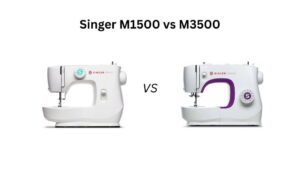
Singer M2100 vs M1500:
Which Beginner Machine Is Worth Your Money?
A complete, no-fluff comparison of features, stitch variety, ease of use, and long-term value — so you buy the right machine the first time.
⚡ Quick Answer: Singer M2100 vs M1500
Both machines are lightweight, budget-friendly mechanical sewing machines built for beginners. The Singer M2100 ($143) gives you more stitch variety — 63 stitch applications across 8 stitch types — plus adjustable stitch length, a darning plate, and a broader presser foot kit. The Singer M1500 ($119) is simpler, slightly cheaper, and sports 57 stitch applications across 6 stitch types with preset lengths. Neither machine has an automatic needle threader.
Bottom line: If you want to grow your skills with more control and stitch options, get the M2100. If you want the absolute easiest setup at the lowest cost, the M1500 is the better pick.
Overview: Singer’s Entry-Level M-Series
Singer has been making sewing machines since 1851 — longer than any other brand on the market. Their M-Series lineup sits at the most approachable end of the product family: lightweight, mechanical, no-frills machines designed specifically for beginners, hobbyists, and casual sewists who don’t need computerized bells and whistles.
The Singer M1500 is the brand’s ultra-entry-level model — essentially a refreshed successor to the beloved Singer Start 1304, simplified down to the essentials. It targets absolute first-timers: children learning to sew, people making their first repair, or experienced sewists who want a lightweight travel machine.
The Singer M2100 steps up the ladder slightly. It shares the same compact, portable form factor but delivers 8 built-in stitch types (vs the M1500’s 6), 63 stitch applications (vs 57), adjustable stitch length, and a more complete accessories kit including a darning plate for free-motion work. It’s the machine for someone who wants to begin sewing and have room to grow.
What makes this comparison genuinely interesting is how similar these machines are on the surface — and how the meaningful differences become crucial depending on your skill goals. That’s exactly what this guide breaks down.
Side-by-Side Buy Options
Both machines are available on Amazon with Prime shipping. Prices current at time of publication.
- 63 stitch applications / 8 stitch types
- Adjustable stitch length & width
- 4-step buttonhole
- LED workspace lighting
- Includes darning plate
- Front-loading Class 15 bobbin
- Lightweight metal frame chassis
- 25-year limited frame warranty
*As an Amazon Associate, we earn from qualifying purchases.
- 57 stitch applications / 6 stitch types
- Preset stitch length & width
- 4-step buttonhole
- LED workspace lighting
- Comes pre-threaded out of box
- Front-loading Class 15 bobbin
- Lightweight metal frame chassis
- 25-year limited frame warranty
*As an Amazon Associate, we earn from qualifying purchases.
Full Specification Comparison
Every spec that matters, side by side. WIN badges indicate where one machine outperforms the other.
| Feature | Singer M2100 | Singer M1500 |
|---|---|---|
| Price | $143 | $119 WIN |
| Machine Type | Mechanical TIE | Mechanical |
| Built-In Stitch Types | 8 WIN | 6 |
| Stitch Applications | 63 WIN | 57 |
| Stitch Length | Adjustable WIN | Preset only |
| Stitch Width | Adjustable WIN | Preset only |
| Buttonhole | 4-Step TIE | 4-Step |
| Bobbin Type | Front-loading Class 15 TIE | Front-loading Class 15 |
| Automatic Needle Threader | No TIE | No |
| LED Light | Yes TIE | Yes |
| Reverse Stitch | Yes TIE | Yes |
| Free Arm | Yes TIE | Yes |
| Drop Feed / Darning Plate | Yes (darning plate included) WIN | No darning plate |
| Twin Needle Compatible | Yes TIE | Yes |
| Pre-Threaded Out of Box | Yes TIE | Yes |
| Presser Feet Included | 4 (+ button sewing foot) WIN | 3 |
| Frame Construction | Metal chassis TIE | Metal chassis |
| Approximate Weight | ~10–12 lbs TIE | ~9.7–11 lbs |
| Warranty (Frame) | 25 Years Limited TIE | 25 Years Limited |
| Best For | Beginners wanting growth room | Absolute first-timers |
Build Quality & Design
Both the M2100 and M1500 share Singer’s standard entry-level construction: a plastic exterior body with an interior metal frame. Don’t let the word “plastic” put you off — the internal metal chassis prevents wobbling and flex during sewing, which is the most important structural element. The outer plastic body is lightweight by design, keeping both machines under 12 lbs for portability.
That said, be clear-eyed: neither of these is a heavy-duty machine. Per Singer’s own product specifications, both models are recommended for basic mending and light-to-medium-weight fabrics. They are not designed for denim in volume, canvas, upholstery, or multilayer quilting sandwiches.
Portability: A True Strong Point
Both machines weigh under 12 pounds, making them genuinely portable. You can carry either machine from a closet to a kitchen table, take it to a sewing class, or pack it for travel with zero strain. Both come with a soft-sided dust cover rather than a hard case — which is standard for this price tier but something to know.
Controls & Usability
Stitch selection on both machines is done via a front-mounted rotary dial — tactile, clear, and impossible to mess up. The M2100 adds separate sliders for stitch length and width adjustment, which the M1500 lacks entirely (preset settings only). Both machines have clearly marked threading paths stamped directly on the body, making setup intuitive even without referencing the manual.
Stitching Performance: Real-World Testing
On Lightweight Fabrics (Cotton, Chiffon, Knits)
Both machines perform well on lightweight fabrics — consistent stitch tension, clean feed, and minimal skipped stitches on standard cotton. The M2100 has a small edge here because its adjustable stitch length lets you tighten stitches for delicate work, which the M1500’s preset settings don’t allow.
On Medium-Weight Fabrics (Poplin, Linen, Poly-blend)
Both machines shine on medium-weight fabrics. This is genuinely the sweet spot for each model. Tension is consistent, the feed dogs grip evenly, and the front-loading Class 15 bobbin system delivers clean, tangle-free bottom stitches. Multiple independent reviews note that the stitch quality on medium-weight cotton is the highlight of both machines.
On Heavier Fabrics (Denim, Canvas)
Both machines can handle single or double layers of denim for occasional mending, but this is not their intended use. Singer explicitly recommends these models for light-to-medium fabrics. For multiple denim layers or thick canvas on a regular basis, you’ll want a heavy-duty model like the Singer Heavy Duty 4411.
Free-Motion Work
This is where the M2100 pulls ahead meaningfully. The included darning plate lets you cover the feed teeth for free-motion sewing — useful for stipple quilting, monograms, or decorative embroidery work. The M1500 doesn’t include a darning plate, so free-motion work is not a viable option without purchasing this accessory separately.
Key Feature Differences: Where the M2100 Earns Its Premium
1. Stitch Variety: 63 Applications vs 57
The M2100 offers 8 built-in stitch types and 63 stitch applications compared to the M1500’s 6 stitch types and 57 stitch applications. In practical terms: the M2100 adds additional utility and decorative stitch options that expand your creative range. For straight hemming or simple repairs, you’ll never notice the difference. For garment construction and craft projects, the extra stitch variety is genuinely useful.
2. Adjustable Stitch Length & Width
This is the most important practical difference between the two machines. The M2100 allows you to manually adjust stitch length and width, giving you control over how your stitches look and how securely they hold across different fabric weights. The M1500 uses preset-only settings — the machine decides the length and width for you. For a pure beginner making basic repairs, presets are actually helpful. For anyone planning to sew garments or develop real skills, adjustable stitch length is a fundamental necessity.
3. Darning Plate (Free-Motion Capability)
The M2100 ships with a darning plate that covers the feed teeth, enabling free-motion sewing for quilting, monogramming, and decorative embroidery. This accessory must be purchased separately for the M1500, typically for around $10–15. A small cost difference, but worth knowing.
4. Presser Feet: 4 vs 3
The M2100 includes four presser feet (all-purpose, zipper, buttonhole, and button sewing foot) compared to the M1500’s three. The button sewing foot is a practical addition for anyone who mends clothing regularly.
5. Everything Else: Identical
Same metal-frame chassis. Same front-loading Class 15 bobbin. Same 4-step buttonhole. Same LED lighting. Same reverse stitch lever. Same 25-year limited frame warranty. Same speed control via foot pedal only. If the four differences above don’t match your use case, the M1500’s lower price makes it the more cost-efficient choice.
🛒 Ready to check today’s prices? Both machines ship free.
Pros & Cons
Singer M2100 — Pros & Cons
- More stitch variety: 8 types, 63 applications
- Adjustable stitch length and width for real control
- Darning plate included for free-motion sewing
- 4 presser feet vs 3 on the M1500
- Good growth room for beginner-to-intermediate transition
- Same compact, portable form factor as M1500
- Strong 25-year limited warranty on frame
- $24 more than the M1500
- No automatic needle threader
- Not suitable for heavy fabrics or industrial work
- Front-loading bobbin less intuitive than top-drop-in
- Some user reports of inconsistent build quality
- Speed controlled by foot pedal only (no slider)
Singer M1500 — Pros & Cons
- Lower price — best entry cost in the Singer M-series
- Preset stitches remove all guesswork for beginners
- Extremely lightweight and easy to store
- Same metal-frame chassis as M2100 for stability
- Comes pre-threaded — sew immediately out of box
- Twin needle compatible for decorative parallel stitching
- 25-year limited frame warranty
- Preset stitch settings — no length or width control
- Fewer stitches: 6 types, 57 applications
- No darning plate (free-motion sewing not included)
- Only 3 presser feet
- No automatic needle threader
- Limited room to grow as skills improve
- Front-loading bobbin requires more practice
Who Should Buy Each Machine?
Our straight recommendation based on sewing goals, experience level, and budget.
Buy the M2100 if you…
- Are a beginner who wants room to grow
- Plan to sew garments, not just repairs
- Want control over stitch length and width
- Are interested in basic free-motion work
- Want more accessories included out of the box
- Are a student taking a sewing class
- Want the most flexible entry-level Singer
Buy the M1500 if you…
- Are an absolute first-timer or a child
- Only need basic mending and simple repairs
- Want the simplest possible setup
- Are on a very tight budget
- Want a lightweight backup / travel machine
- Prefer preset stitches with zero guesswork
- Don’t anticipate needing advanced features
📌 Featured Snippet: Singer M2100 vs M1500 — Quick Decision Guide
- More stitch control & variety? → Singer M2100
- Lowest price & simplest setup? → Singer M1500
- Free-motion sewing included? → Singer M2100 (darning plate included)
- Best for a child learning to sew? → Singer M1500
- Best for garment making & crafts? → Singer M2100
- Both have automatic needle threader? → No, neither model
- Both handle heavy fabrics? → No — both rated for light-to-medium fabrics only
- Warranty? → Both: 25-year limited frame warranty from Singer
Final Verdict
These two machines are close siblings, not distant competitors. The Singer M2100 wins on features — more stitch types, adjustable stitch control, free-motion capability, and more accessories. The Singer M1500 wins on simplicity and price. The $24 gap is not life-changing, but the feature gap could matter a great deal depending on your sewing goals.
Our recommendation: most beginners will be happier with the M2100. The adjustable stitch length alone — absent on the M1500 — is a feature that becomes genuinely important as soon as you move beyond mending into actual garment sewing. Spending $24 more now for more flexibility is almost always better than feeling limited and needing to upgrade in six months.
That said, if your sole purpose is basic repairs — hemming a pair of trousers, fixing a seam, sewing a simple tote bag — the M1500 does the job perfectly well at a lower price point. It’s a machine that excels at what it’s designed for.
For beginners who want stitch control, more variety, and room to grow. The adjustable stitch length and included darning plate make this the smarter long-term investment at just $24 more.
View on Amazon → $143For absolute first-timers, children, or anyone who just needs mending and basic repairs done at the lowest cost. Preset stitches mean zero guesswork — plug in and start sewing.
View on Amazon → $119Frequently Asked Questions
What is the main difference between the Singer M2100 and M1500?
The M2100 has more built-in stitch types (8 vs 6), more stitch applications (63 vs 57), adjustable stitch length and width (the M1500 uses preset-only settings), and includes a darning plate for free-motion sewing. Both machines share the same metal frame chassis, 4-step buttonhole, LED light, front-loading bobbin system, and 25-year limited frame warranty.
Is the Singer M2100 worth the extra $24 over the M1500?
For most beginners, yes. The adjustable stitch length alone is a significant upgrade — it gives you the ability to fine-tune stitches for different fabrics, which is essential for real garment sewing. The included darning plate also unlocks free-motion work that requires a separate purchase on the M1500. If you plan to develop sewing skills, the M2100’s extra features are worth the modest price difference.
Can the Singer M2100 or M1500 sew denim?
Both machines can handle occasional, single-layer denim mending, but Singer officially classifies both as light-to-medium fabric machines. For regular denim sewing or multiple layers, a heavy-duty model like the Singer 4411 or 4423 is the better choice. Always use a denim needle (size 90/14 or 100/16) and go slowly when attempting denim on either machine.
Do the Singer M2100 and M1500 have automatic needle threaders?
No — neither machine includes an automatic needle threader. You’ll need to thread the needle by hand. If this is a concern, the Singer M3300 is the entry-level Singer model that adds this feature.
Which machine is better for a complete beginner?
Both are designed for beginners, but they serve different beginner types. The M1500 is better for children or adults who just want to make quick repairs without any complexity — preset stitches mean you can start sewing immediately. The M2100 is better for beginners who plan to sew garments, do crafts, or develop real sewing skills over time, thanks to adjustable stitch settings and more stitch variety.
Can I do free-motion quilting on the Singer M1500 or M2100?
The M2100 includes a darning plate, which lets you cover the feed teeth for basic free-motion sewing — including stipple quilting and simple embroidery. The M1500 does not include a darning plate, so free-motion work is not practical without purchasing that accessory separately. Neither machine is a dedicated quilting machine, but the M2100 supports basic free-motion work out of the box.
What bobbin type do the Singer M2100 and M1500 use?
Both machines use a front-loading Class 15 (transparent plastic) bobbin. Note that front-loading bobbins require a bit more practice to insert correctly compared to the top-drop-in bobbin system found on some other beginner machines like the Brother XM2701.
What warranty does Singer offer on the M2100 and M1500?
Both machines carry Singer’s standard warranty: a 25-year limited warranty on the product frame, plus additional coverage on electrical components and labor (terms vary by region). Warranty claims must be submitted through an authorized Singer dealer. Full warranty terms are available on Singer’s official website.
📦 Don’t wait — check today’s Amazon prices before they change.