Janome HD1000 vs HD3000:
Which Machine Wins?
A comprehensive, spec-verified breakdown of stitches, bobbin systems, presser foot control, and real-world performance — so you buy with confidence.
Janome HD1000 vs HD3000: The Short Version
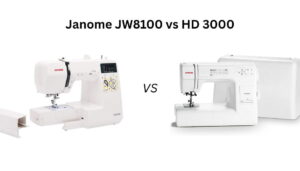
Both are mechanical heavy-duty sewing machines with cast aluminum bodies built to last decades. The core difference comes down to three things: the HD3000’s top-loading rotary bobbin (vs the HD1000’s front-loading oscillating hook), its adjustable presser foot pressure, and a significantly wider stitch library (18 stitches + one-step buttonhole vs 14 stitches + four-step buttonhole). At a $30 price gap, the HD3000 is the stronger purchase for most sewists.
Choose the HD3000 ($429) if you work with varied fabrics, want effortless bobbin loading, and sew buttonholes more than occasionally. Choose the HD1000 ($399) if you’re strictly budget-conscious, a raw beginner, or need the simplest possible mechanical machine for occasional light-to-medium projects.
Overview: The Janome HD Series
Janome — the Japanese sewing machine brand founded in 1921 as The Pine Sewing Machine Factory — has earned a global reputation for building mechanical workhorses that outlast their owners. Their HD (Heavy Duty) lineup, anchored by the HD1000 and HD3000, sits in a purposeful sweet spot: sturdier than budget plastic-body machines, more accessible than full industrial models.
Both machines wear an all-cast aluminum body and internal frame — the same material philosophy Janome highlights on its official product pages as the cornerstone of the HD line. This isn’t marketing language: aluminum construction eliminates the chassis flex that causes stitch quality to degrade on plastic machines when you’re pushing through multiple denim or canvas layers.
What makes this comparison interesting is just how close these two machines are at their core — and how meaningful the differences become when you look at daily use. This guide breaks down every point of distinction so you can match the right machine to your sewing style.
Side-by-Side Buy Options
Both machines are available on Amazon with free Prime shipping. Always check current pricing — these machines do go on sale.
Janome HD1000
The No-Frills Beginner Workhorse
- Cast aluminum body & frame
- 14 built-in stitches
- 4-step buttonhole
- Front-loading oscillating hook
- 5mm max stitch width
- 860 SPM max speed
- Built-in needle threader
- Hard cover included
- 25-year frame warranty
*As an Amazon Associate, we earn from qualifying purchases.
Janome HD3000
The Feature-Rich All-Rounder
- Cast aluminum body & frame
- 18 built-in stitches
- One-step automatic buttonhole
- Top-loading rotary hook bobbin
- 6.5mm max stitch width
- Adjustable presser foot pressure
- Built-in needle threader
- Hard cover + reference guide
- 25-year frame warranty
*As an Amazon Associate, we earn from qualifying purchases.
Full Specification Comparison
Every spec that matters, side by side. Verified against Janome’s official HD1000 and HD3000 product pages. Green badges indicate where one machine outperforms the other.
| Feature | Janome HD1000 | Janome HD3000 |
|---|---|---|
| Pricing & Identity | ||
| Price (Amazon) | $399 WIN | $429 |
| Machine Type | Mechanical | Mechanical |
| Body Construction | Cast aluminum TIE | Cast aluminum |
| Country of Origin | Thailand | Thailand |
| Stitches & Buttonhole | ||
| Built-in Stitches | 14 | 18 WIN |
| Buttonhole Type | 4-Step (manual) | 1-Step (automatic) WIN |
| Max Stitch Width | 5mm | 6.5mm WIN |
| Max Stitch Length | 4mm TIE | 4mm |
| Stitch Selection | Dial | Dial + flip-up reference panel |
| Bobbin & Hook System | ||
| Bobbin Loading | Front-loading (oscillating) | Top-loading (rotary) WIN |
| Hook Type | Vertical Oscillating Hook | Full Rotary Hook WIN |
| Bobbin Winding | Push-Pull | Auto-DeClutch WIN |
| Feed & Foot System | ||
| Feed Dog | 3-Piece | 5-Piece WIN |
| Presser Foot Pressure | Not adjustable | Adjustable (dial) WIN |
| Extra-High Presser Lift | Yes TIE | Yes |
| Presser Foot Type | Snap-on TIE | Snap-on |
| Drop Feed (free motion) | Yes TIE | Yes |
| Free Arm | Yes TIE | Yes |
| Controls & Automation | ||
| Built-in Needle Threader | Yes TIE | Yes |
| Thread Tension Control | Manual TIE | Manual |
| Reverse Stitch Lever | Yes TIE | Yes |
| Max Sewing Speed | 860 SPM TIE | 860 SPM |
| Workspace & Dimensions | ||
| Workspace (Width × Height) | 6.4″ × 4.7″ | 6.5″ × 4.6″ TIE |
| Machine Footprint | 15.6″ × 12.4″ × 6.3″ | 16″ × 11.3″ × 7.2″ |
| Machine Weight | 16.8 lbs | 18.7 lbs |
| Hard Cover Included | Yes TIE | Yes |
| Warranty | ||
| Frame Warranty | 25 years TIE | 25 years |
| Electrical Warranty | 5 years TIE | 5 years |
| Labor Warranty | 1 year TIE | 1 year |
| Best For | ||
| Ideal User | Absolute beginners, occasional sewists on a strict budget | Beginners to intermediate, garments, repairs, diverse fabrics |
Sources: Janome HD1000 Official Page · Janome HD3000 Official Page
Build Quality & Design
Both the HD1000 and HD3000 are built around Janome’s trademark cast aluminum body and internal frame. According to Janome’s own product introduction, this construction eliminates the flex and vibration issues that plague plastic-body machines when working through multiple layers. The aluminum body is chip-resistant, matte-finished, and — crucially — houses fully metal internal components including the feed dogs, needle mechanism, and hook assembly.
The HD1000 weighs in at 16.8 lbs while the HD3000 adds a couple of pounds at 18.7 lbs, reflecting its slightly more robust internal architecture. Both are portable by heavy-duty standards, and both include a hard cover — a practical addition that makes transporting to sewing classes or a second workspace genuinely feasible.
Ergonomics & Daily Usability
Stitch selection on both machines is handled via a front-mounted dial — tactile, intuitive, and maintenance-friendly. The HD3000 adds a flip-up reference chart inside the top tray door that shows recommended presser feet, stitch settings, and tension adjustments for common project types. This is a small but genuinely useful feature that beginners consistently cite as valuable.
The extra-high presser foot lift — present on both models — provides the clearance needed for thick quilting sandwiches or stacked denim layers. Both machines feature a free arm for sewing sleeves, cuffs, and trouser legs.
Durability note: Janome machines built with aluminum frames are known to last 20–30 years with proper maintenance. The 25-year frame warranty on both models reflects that confidence.
Stitching Performance
On paper, both machines share a 860 SPM motor and a 4mm maximum stitch length. In practice, the differences in bobbin system and feed architecture create meaningful performance gaps that are felt most on demanding projects.
On Lightweight Fabrics (Cotton, Chiffon, Lawn)
Both machines handle delicate fabrics well. Stitch quality is clean and consistent on cotton and lawn. Neither machine “eats” fabric at seam starts — a common issue with cheaper home machines that both the HD1000 and HD3000 avoid. At slow speeds, both deliver adequate precision for intricate work. On silky, slippery fabrics however, the HD3000’s adjustable presser foot pressure provides an edge: reducing the pressure prevents the feed dog from distorting the fabric as it moves.
On Medium-Weight Fabrics (Denim, Linen, Canvas)
This is the natural territory of the HD series. Both machines push through mid-weight materials smoothly. The HD3000’s rotary hook system — as opposed to the HD1000’s oscillating hook — creates a more continuous, smoother stitch formation that is less prone to thread loops and skipped stitches at variable speeds.
On Heavy/Layered Fabrics & Leather
The aluminum frame earns its keep here. The HD3000 handles heavier materials — including thin-to-medium leather — with significantly more consistency than the HD1000. Independent reviewers at Sewing Insight noted that the HD1000 can struggle at slow speeds on layered leather, requiring hand-wheeling over thick seams, while the HD3000 produces minimal skipped stitches even at reduced pace. For everyday denim and canvas, both machines perform well with appropriate needle selection (90/14 for denim).
Buttonhole Quality
This is a clear HD3000 advantage. The one-step automatic buttonhole produces consistent, clean results across fabrics. The HD1000’s four-step buttonhole process is more manual — and more prone to uneven results until you’ve developed technique. As one reviewer at Sewing Insight observed, HD1000 buttonholes can look uneven unless you carefully stabilize the fabric through each manual step.
5 Key Feature Differences
1. Bobbin System: Front-Loading vs Top-Loading
This is arguably the biggest practical difference for daily use. The HD1000 uses a front-loading bobbin with a vertical oscillating hook — a traditional design that works well but requires removing a bobbin case each time you reload. You cannot monitor the thread supply without stopping. The HD3000’s top-loading drop-in bobbin lets you see the bobbin at a glance through the transparent cover, reload in seconds, and benefits from a full rotary hook that operates more smoothly and consistently at variable speeds. According to Sewing Machines Plus and multiple user reviews, this difference alone is enough to move most sewists to the HD3000 once experienced.
2. Presser Foot Pressure: Adjustable vs Fixed
The HD3000 includes a dial to adjust presser foot pressure — a feature that allows the feed dog to interact with fabric more or less forcefully depending on what you’re sewing. On delicate fabrics, you reduce the pressure to prevent distortion; on thick layers, you increase it to maintain feeding. The HD1000 has no such adjustment. As detailed on Comparencart’s comparison, this is theoretically the governing factor for stitch consistency, top-to-bottom fabric matching, and thread tension across fabric types.
3. Stitch Library: 14 vs 18 Stitches
The HD3000 adds 4 extra built-in stitches over the HD1000’s 14, giving sewists more decorative and utility options without additional accessories. The practical impact depends on your work: garment sewists doing mostly straight stitch and zigzag may find the HD1000’s 14 stitches sufficient, while quilters and home décor enthusiasts tend to reach for the additional patterns regularly.
4. Buttonhole Mechanism: One-Step vs Four-Step
The HD3000’s automatic one-step buttonhole is a considerable usability upgrade. Attach the buttonhole foot, insert a button for sizing reference, and the machine handles the entire process automatically with consistent results. The HD1000 requires manually cycling through four separate stitch sequences — achievable, but slower and more error-prone, especially on fabrics that shift during the process.
5. Stitch Width: 5mm vs 6.5mm
The HD3000’s 6.5mm maximum stitch width vs the HD1000’s 5mm creates noticeable differences in zigzag overcast seaming, satin-stitch appliqué, and decorative topstitching. A wider zigzag creates stronger overcast edges on ravelly fabrics, and the HD3000’s wider satin stitch has noticeably more presence on appliqué work. For straight-stitch garment sewing, the difference is irrelevant. For decorative and finishing work, it’s appreciated.
💡 Bottom line on the price gap: At only $30 more, the HD3000 delivers five meaningful upgrades over the HD1000. The value equation strongly favors the HD3000 for anyone who will use the machine more than occasionally.
Ready to Check Current Amazon Prices?
Prices on both machines fluctuate. Lock in the best deal before it changes.
Pros & Cons
Janome HD1000
- $30 cheaper — lowest cost entry into Janome heavy-duty
- Same cast aluminum frame as the HD3000
- Lighter at 16.8 lbs — marginally more portable
- Even Feed (walking) foot included in the box
- Ultra Glide foot for leather included
- Straightforward dials — near-zero learning curve
- 25-year frame warranty identical to HD3000
- Built-in needle threader for easy setup
- Front-loading bobbin — cannot monitor thread supply
- No presser foot pressure adjustment
- Only 14 stitches — limited decorative options
- Four-step buttonhole — inconsistent results for beginners
- 5mm max stitch width limits zigzag/satin stitch quality
- Oscillating hook less smooth than HD3000’s rotary system
- Struggles at slow speeds on layered leather
- Needle cannot be shifted left/center
Janome HD3000
- Top-loading drop-in bobbin — faster, easier, visible
- Full rotary hook for smoother, more consistent stitching
- 18 stitches — broad utility and decorative options
- One-step automatic buttonhole — professional results
- 6.5mm stitch width for bold decorative and overcast stitches
- Adjustable presser foot pressure for all fabric types
- Flip-up stitch reference chart — great for beginners
- Outstanding value at only $30 more than HD1000
- $30 more expensive than the HD1000
- Slightly heavier at 18.7 lbs
- No walking foot included (available separately)
- Still a manual machine — no speed control slider
- Not computerized — no needle up/down function
- Accessories use 5-7mm system (not interchangeable with HD1000)
Who Should Buy Each Machine?
Buy the HD1000 if you are…
- An absolute beginner on the tightest budget
- A casual sewist who repairs clothes occasionally
- Someone who sews mostly straight lines on cotton fabrics
- A parent buying a first machine for a teen learning to sew
- Someone who values the walking foot being included in the box
- A sewist who prefers the feel of a traditional front-load bobbin
- Looking for a lightweight spare machine for a second studio
Buy the HD3000 if you are…
- A beginner who wants to grow into the machine
- Someone who sews garments, bags, or home décor regularly
- Anyone sewing through denim, canvas, or multiple layers
- A sewist who makes buttonholes more than rarely
- Someone working with varied fabric weights in one project
- A sewist who wants the convenience of a top-load bobbin
- Anyone doing light quilting or decorative stitch work
- Someone who wants the best long-term value for $30 more
💡 The $30 Question: If you’re genuinely torn, consider this — the HD3000’s upgrades (rotary bobbin, adjustable foot pressure, 4 extra stitches, one-step buttonhole, wider stitch width) collectively represent features you’d pay $50–$100 to add to any other machine via accessories or upgrades. At $30 more, the HD3000 is the more rational purchase for almost every sewist.
Final Verdict
Two outstanding mechanical sewing machines. One clear recommendation — if you know what you need.
Janome HD1000
For absolute beginners, occasional sewists, and those on the strictest budget who need a durable, simple machine for light-to-medium work. Walking foot included is a nice bonus.
View on Amazon → $399*Affiliate link. Price may vary.
Janome HD3000
For beginners, intermediate sewists, and anyone who wants to grow into their machine. The rotary bobbin, adjustable presser foot, and automatic buttonhole alone justify the $30 premium over the HD1000.
View on Amazon → $429*Affiliate link. Price may vary.
Frequently Asked Questions
Don’t Wait — Check Today’s Prices
Amazon prices on both machines change frequently. Check current deals before buying.