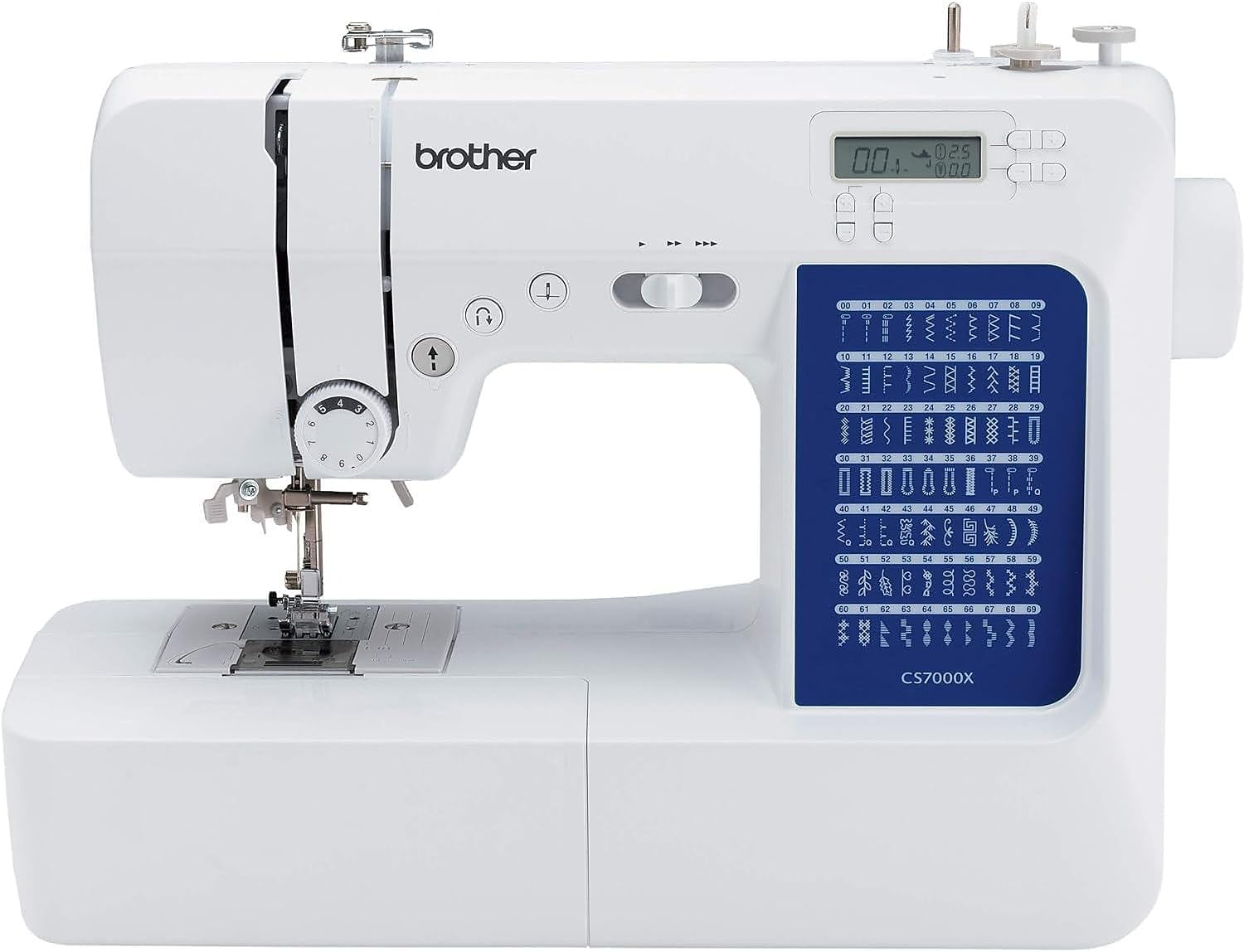
Current Price: $279
Perfect if you:
- Are teaching a child to sew (speed control is essential)
- Quilt regularly (wide table included)
- Need to transport your machine (hard case included)
- Sew garments/bags with lots of zippers
- Want less tension fussing (improved mechanism)

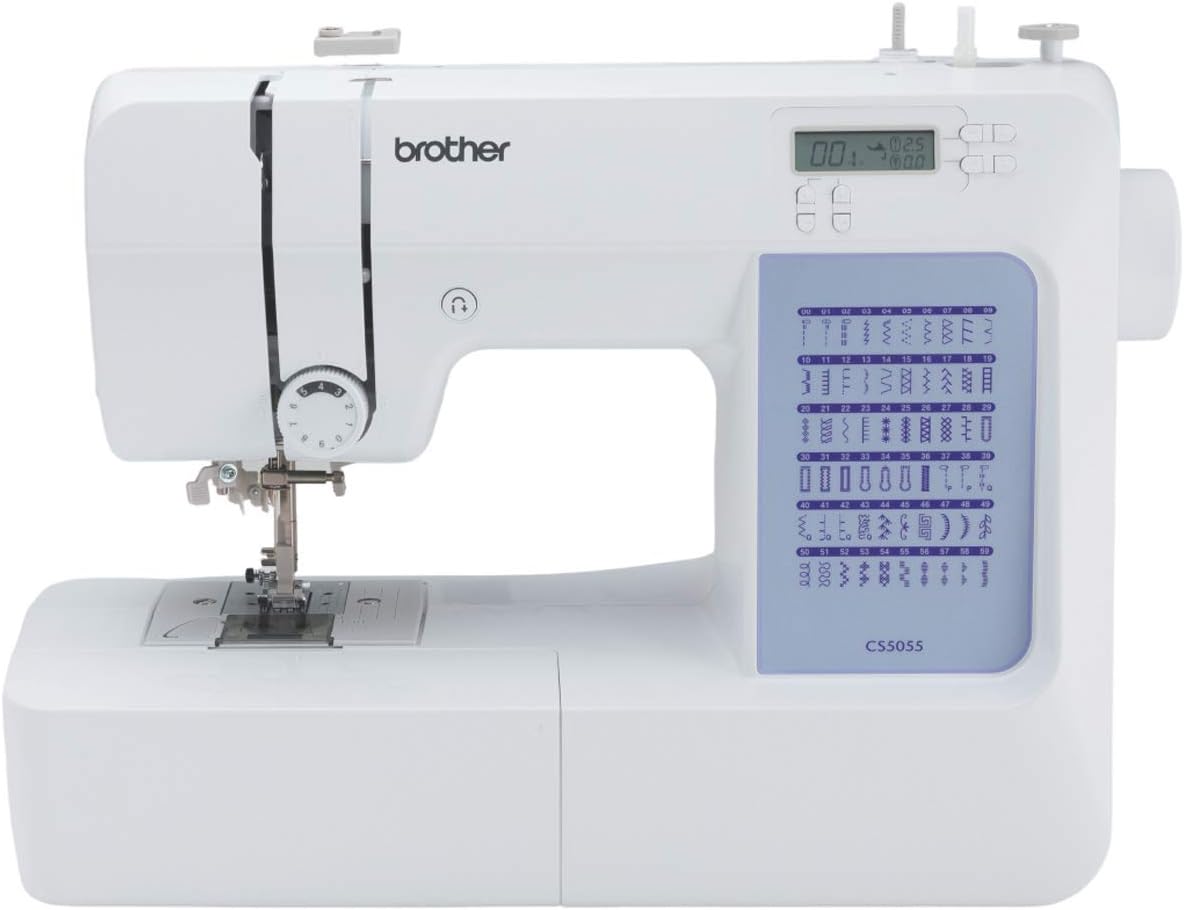
Current Price: $198
Perfect if you:
- Are learning to sew as an adult
- Don't need portability (machine stays at home)
- Want quieter operation for apartments
- Prefer metal internal components
- Plan basic sewing, alterations, or simple quilting
Introduction
You’re about to spend $200-280 on a sewing machine, and you keep seeing the same two names: Brother CS5055 ($198) and Brother CS7000X ($279).
Here’s what nobody tells you: these machines are almost identical where it matters. Same motor. Same 60 core stitches (CS7000X adds 10 decorative ones you’ll likely never use). Same stitch quality. Same metal frame. Same reliability issues.
So what are you actually paying $81 extra for?
That’s the question that kept me digging through user reviews, forum threads, and testing data. Because if you’re like most people shopping for entry-level sewing machines, you don’t need another specs comparison – you need to know if that price difference actually solves a problem you have.
Let me show you what I found.
Table of Contents
TL;DR
The CS7000X ($279) is worth it if you’re teaching kids (speed control), quilting (wide table), or need portability (hard case). Otherwise, the CS5055 ($198) delivers nearly identical performance. The real price gap is only $46 when you factor in included accessories, making this less about budget vs premium and more about which specific features solve your problems.
Related Articles:
At-a-glance: Brother CS5055 vs CS7000X
| Features | CS5055 | CS7000X |
|---|---|---|
| Price | $198 | $279 |
| Built-in Stitches | 60 | 70 |
| Speed Control Slider | ❌ | ✅ |
| Hard Carrying Case | ❌ | ✅ |
| Wide Extension Table | ❌ | ✅ |
| Presser Feet Included | 7 | 10 |
| Weight | 10.5 lbs | 10.5 lbs |
| Best For | Adult learners, basic sewing, quiet operation | Teaching kids, quilting, portability needs |
| Avoid If | You sew lots of zippers, need portability | You want quieter operation, metal internals only |
| Where To Buy | Check On Amazon | Check On Amazon |
The Real Cost Is $46, Not $81
Start here because it changes everything.
The CS7000X includes a hard carrying case. Decent ones cost $30-40 separately. It also includes a wide extension table for quilting – another $25-30 if you buy it separately for the CS5055.
Do the math:
The real price difference? About $21 if you need those accessories. About $46 if you only need the case.
Suddenly this isn’t about budget vs premium. It’s about which accessories you actually need and four specific features that matter intensely to some sewers and mean absolutely nothing to others.
Problem #1: You’re Teaching Someone to Sew (Especially a Child)
This is where the CS7000X earns its price premium.
The speed control slider lets you cap the maximum speed anywhere from 0-100%. Your 6-year-old can press the foot pedal all the way down, but the machine only runs at 40% speed. They feel in control. You don’t have a runaway presser foot.
The CS5055 runs at one speed: whatever pressure you apply to the pedal. For adults learning to sew, this is fine. The pedal isn’t overly sensitive. But for children under 10? Multiple parents on quilting forums specifically mentioned this as their deal-breaker feature.
One reviewer put it perfectly: “I use the speed control on my Brother so that my 5-year-old can press the pedal and help me sew. She gets excited and just mashes the pedal – without the speed limiter, she’d be terrified when the machine took off.“
If you’re teaching kids: The CS7000X’s speed control isn’t a convenience feature. It’s the difference between a child who loves sewing and one who’s afraid of the machine.
If you’re learning as an adult: Save the $81. You don’t need it.
Problem #2: You’re Sewing Projects With Lots of Zippers
The CS5055 has a zipper foot problem that Brother hasn’t fixed.
Multiple independent testers report the zipper foot “felt like it barely held on and was lopsided” with “uneven stitching and tension from one side to the other.” TechGearLab documented this in their 2022 testing, and forum posts from 2025 still mention it.
Does every CS5055 have this issue? No. Is it common enough that you should worry about it if you’re planning to install 20 zippers in the next year? Yes.
The CS7000X doesn’t have this problem. The presser feet snap on more securely across the board.
If you’re sewing garments, bags, or cushions with frequent zippers: Spring for the CS7000X. Struggling with a wobbly zipper foot will drain your sanity fast.
If you’re doing quilts, simple alterations, or basic home decor without zippers: The CS5055 works fine.
Problem #3: You’re Quilting Regularly
The wide extension table on the CS7000X creates about 10 extra inches of flat workspace left of the needle. For quilting large pieces, this is huge. You’re not wrestling with fabric weight pulling down off the machine.
The CS5055 has the standard small workspace. You can buy an extension table separately ($25-30), but you’re closing that price gap fast.
The CS7000X also includes a 1/4″ quilting foot, which is essential for piecing with accurate seam allowances. The CS5055 doesn’t come with this (you’d buy it separately for $8-12).
If you’re planning regular quilting projects: The CS7000X pays for itself immediately. Extension table + quilting foot + hard case for transport to quilting groups = $279 is actually cheaper than CS5055 + buying those accessories.
If you’re doing basic sewing repairs and small projects: You don’t need the workspace. Save the money.
Problem #4: You Live in an Apartment or Sew While Kids Nap
Here’s something the spec sheets don’t tell you: the CS5055 runs noticeably quieter than most mechanical Brothers.
We’re not talking about a whisper-quiet machine – it’s still a sewing machine. But the sound level difference matters if you have thin walls, sleeping children, or roommates. The CS7000X at full speed is measurably louder.
At slower speeds (which the CS7000X can do with its speed control), both machines are comparable. But the CS5055’s default noise level is lower.
If noise is a genuine concern: The CS5055 gives you quieter operation by default. The CS7000X can be made quieter by limiting the speed control, but you’re paying $81 for the privilege of running a louder machine slower.
Problem #5: You Want to Learn Proper Sewing Technique
This is going to sound backwards, but stick with me.
The CS5055 has “consistent tension trouble with most stitches on most fabrics,” according to TechGearLab’s testing. Reviewers consistently mention needing to adjust tension more frequently than expected.
The CS7000X’s computerization and improved tension mechanism mask a lot of these issues. Your stitches look better with less fiddling.
Here’s the controversial take: the CS5055’s temperamental tension actually makes you a better sewer faster.
When your stitches look wrong, you learn to recognize thread tension issues. You learn why your seams are puckering. You understand the relationship between tension, fabric weight, and thread type. These are fundamental skills that separate someone who can “use a sewing machine” from someone who can “sew well.”
Starting on a more forgiving machine (CS7000X) means you don’t develop these diagnostic skills early. You learn to adjust the machine’s settings but not to understand what’s actually happening with the thread and fabric.
If you want to become a skilled sewist long-term: The CS5055’s learning curve might actually be an advantage. You’ll understand your next machine better.
If you want to start making things immediately with less frustration: The CS7000X’s improved tension system will make your first projects look better faster.
Problem #6: You Need Portability
The CS7000X includes a hard case. The CS5055 doesn’t.
If you’re taking the machine to classes, retreats, or a friend’s house, this matters. A quality hard case protects the machine during transport and gives you organized storage for presser feet and accessories.
Both machines weigh the same (10.5 lbs), so weight isn’t a factor. But CS5055 owners who need portability end up buying a case anyway – and now that $81 price gap is down to $40-50.
If your machine stays on a dedicated sewing table: Skip the CS7000X. You’re paying for a case you’ll never use.
If you need to move it regularly: The CS7000X’s included case is worth $30-40 of that price difference.
The Plastic Parts Concern Nobody Mentions
Here’s something strange: the CS7000X costs more but has more plastic internal components.
The CS5055 uses metal parts for the presser foot holder, upper thread guide, bobbin winding disc, and tension disc. The CS7000X (released in 2020, newer than CS5055) replaced several of these with plastic equivalents. The presser foot holder, bobbin winding disc, and parts of the tension assembly are now plastic.
Why does this matter? Durability is a question mark.
Both machines have metal frames – that’s not the issue. But plastic tension discs and presser foot holders are more likely to wear, strip, or break over time than metal ones. The CS7000X is newer, so we don’t have 5+ years of durability data yet.
This doesn’t mean the CS7000X will break faster. It means we don’t know if it will hold up as long as machines with all-metal internals.
If you’re planning to sew heavily (multiple projects per month for years): The CS5055’s metal internals are proven. The CS7000X’s plastic parts are an unknown.
If you’re an occasional sewer (few projects per year): This won’t matter. You’ll likely outgrow the machine before the plastic parts fail.
Both Machines Have the Same Weaknesses
Let’s be honest about what you’re buying regardless of which model you choose.
Buttonholes are mediocre on both. This is a Brother-wide issue. The automatic buttonhole feature works, but results aren’t consistently clean. Expect some thread bunching at the corners and occasionally uneven spacing. If you’re sewing lots of garments with buttonholes, you might want to look at Singer machines instead – they handle buttonholes better in this price range.
The needle threader will probably break. Brother’s automatic needle threaders are wonderfully convenient when they work and frustrating when they don’t. Expect this to fail within 2-3 years on either machine. The CS7000X has an “improved” version, but user reports suggest it still breaks – just maybe slightly less often.
The expected lifespan is 2-3 years of regular use. These are entry-level machines with entry-level durability. If you’re sewing multiple projects every month, components will wear out. The motor will lose power. Plastic gears will strip. This is reality at the $200-280 price point.
Neither machine is a “buy it for life” tool. They’re “learn on this and upgrade when you outgrow it” tools.
Don’t overthink this decision based on 10-year speculation. Buy based on what you need for the next 18-24 months. You’ll either outgrow both machines or be ready to upgrade to something better by then anyway.
The Shadow and Lighting Problem on CS5055
Small annoyance that might matter: the CS5055’s work light creates a shadow exactly where the needle enters the fabric. The light is bright on the right side but dark on the left.
This is annoying for detailed work. You’ll find yourself leaning over to see clearly or adding a secondary light source.
The CS7000X has better lighting placement. No shadow problem.
Is this worth $81? No. Is it worth knowing about before you buy? Yes. A $15 clip-on LED sewing light solves this problem completely.
The Hidden “Same Machine” Secret
The CS5055 is also sold as the Brother CP60X. Same machine. Different faceplate. That’s it.
Brother marketed the CP60X as a “Project Runway” edition with a $20-30 premium that has now disappeared. If you find a CP60X on sale, it’s identical to the CS5055.
Why does this matter? Deal hunting. Sometimes retailers blow out old stock of the CP60X at $150-170. That’s the same machine as the CS5055 for less money.
The Four Features That Actually Matter
Strip away the marketing and here’s what that $81 really buys:
- Speed control slider – Essential for teaching kids, irrelevant for adults
- Hard case – Worth $35 if you need portability
- Wide extension table – Worth $25-30 if you quilt
- Better zipper foot stability – Matters if you sew lots of zippers
That’s it. Everything else is incrementally different or marketing fluff.
Add up the value of the features YOU need. If it’s close to $81, the CS7000X makes sense. If it’s not, save the money.
Making the Decision Easy: Brother CS5055 vs CS7000X
Choose the CS5055 at $198 if:
Current Price: $198
Perfect if you:
- Are learning to sew as an adult
- Don't need portability (machine stays at home)
- Want quieter operation for apartments
- Prefer metal internal components
- Plan basic sewing, alterations, or simple quilting
- You’re learning to sew as an adult (no kids involved)
- Your projects are mostly quilts, home decor, or simple alterations
- The machine will stay in one place (no portability needed)
- You’re not installing lots of zippers
- You value quieter operation
- You’d rather put that $81 toward fabric, patterns, or better scissors
Choose the CS7000X at $279 if:
Current Price: $279
Perfect if you:
- Are teaching a child to sew (speed control is essential)
- Quilt regularly (wide table included)
- Need to transport your machine (hard case included)
- Sew garments/bags with lots of zippers
- Want less tension fussing (improved mechanism)
- You’re teaching a child to sew (speed control earns its keep)
- You quilt regularly and need the wide table
- You need portability (the hard case matters)
- You’re sewing garments/bags with frequent zippers
- You want the path of least resistance (better tension, fewer adjustments)
- The $81 difference isn’t significant to your budget
Choose a used CS6000i at $150-180 if:
- You want the best value and don’t mind buying secondhand
- You’re not sure sewing will stick as a hobby
- You’re willing to test the machine before buying
The Bottom Line: Brother CS5055 vs CS7000X
The Brother CS7000X isn’t better. It’s different.
If you need a speed control for teaching, a wide table for quilting, and a case for transport, you’re paying fair market value for useful upgrades. The $81 premium makes sense.
If you don’t need those specific things, the CS5055 delivers nearly identical performance for 71% of the price. It’s not settling for less – it’s buying exactly what you need.
Either way, you’re getting a capable beginner machine that will serve you well for 2-3 years before you outgrow it or upgrade. Neither will last forever. Neither is perfect. Both will teach you to sew.
The only wrong choice is spending three more weeks agonizing over this decision instead of making something.
Pick the one that solves your specific problems. Buy it. Start sewing.
FAQs
Q: What’s the main difference between CS5055 and CS7000X?
Four features: speed control slider, hard case, wide extension table, and 10 extra decorative stitches. Same motor, stitch quality, and frame.
Q: Is the CS7000X worth the extra $81?
Only if you need the speed control for teaching kids, wide table for quilting, or hard case for portability. Otherwise, no.
Q: Which is better for beginners?
CS5055 if you’re an adult learning alone. CS7000X if you’re teaching a child (speed control matters).
Q: Do both machines have the same stitch quality?
Yes. Same motor, same core 60 stitches, same metal frame. CS7000X adds 10 decorative stitches most people never use.
Q: How long will these machines last?
2-3 years with regular use. These are entry-level machines meant for learning, not lifetime tools.
Q: Can I buy the CS5055 accessories separately?
Yes. Hard case ($35) and wide table ($25-30) can be purchased separately, which closes the price gap significantly.